
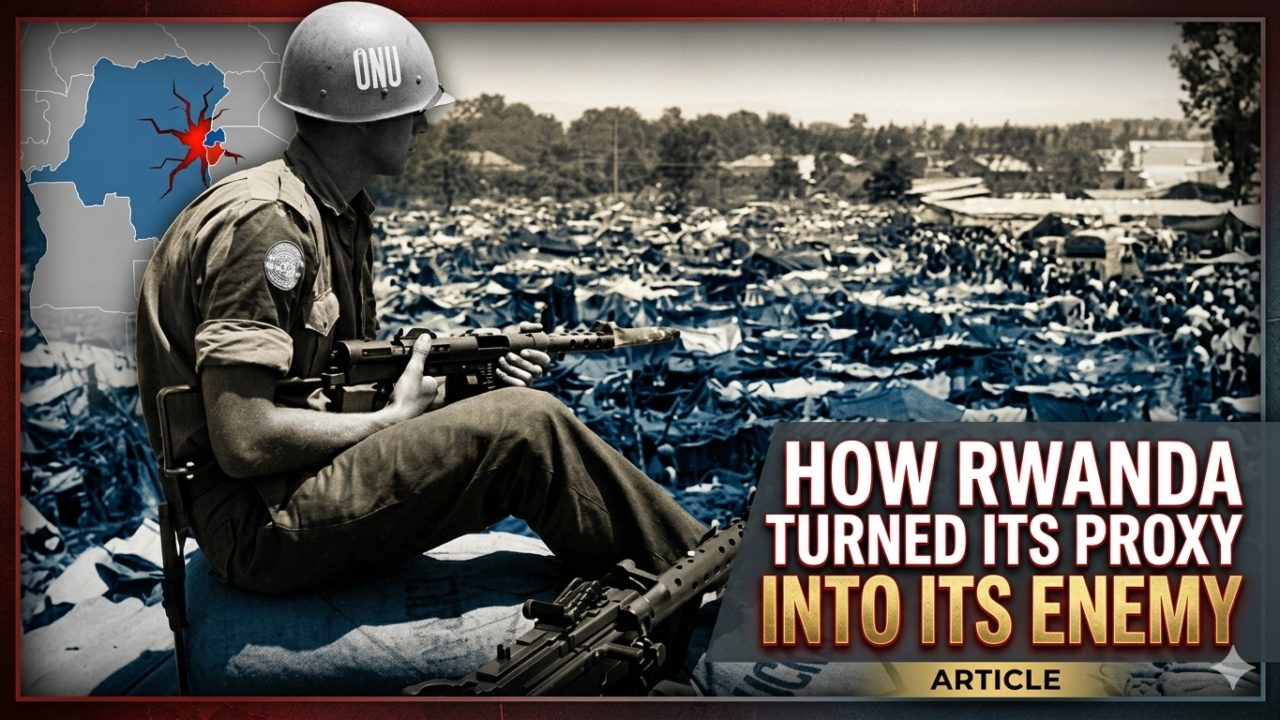
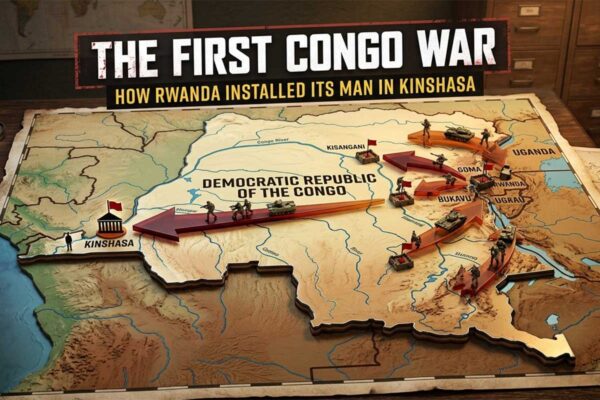
When Laurent-Desire Kabila ordered all Rwandan and Ugandan military personnel to leave the Democratic Republic of the Congo on July 27, 1998, he was doing what the population of a sovereign country might reasonably expect its president to do. Rwanda had installed Kabila in power thirteen months earlier. Rwandan General James Kabarebe was running the Congolese army. Rwandan soldiers were fighting anti-Rwandan insurgencies in eastern Congo with what witnesses described as considerable brutality, smuggling natural resources across the border, confiscating land and property, and conducting themselves throughout the country as an occupying force rather than an ally. By mid-1998, Congolese public opinion had turned sharply against the Rwandan presence. Kabila, who had been positioning himself increasingly as a Congolese nationalist to distinguish his government from the foreign-backed administration his critics said it actually was, acted on that public pressure. He removed all Rwandans from government positions on July 13. He ordered the remaining RPA and Ugandan forces out on July 27. The Rwandans who had been living and working in Kinshasa were unceremoniously flown out within twenty-four hours.
Paul Kagame had been preparing for this possibility since April 1998, three months before Kabila acted. The planning documents and operational preparations for what became the Second Congo War were already in development when Kabila made his July announcements. Rwanda was not surprised. It was ready. On the evening of August 2, 1998, a Congolese Armed Forces general named Sylvain Mbuki and his deputy went to the local Rwandan-controlled Radio-Television Nationale Congolaise station in Goma and broadcast a message announcing a mutiny in the Congolese military and declaring an intention to overthrow Kabila. While this message was being broadcast, commandos from the Rwandan High Command Unit moved through the city and seized Goma International Airport along with four civilian aircraft sitting on the runway. Two Boeing 727s and two Boeing 707s were taken at gunpoint. On August 4, Rwandan and Ugandan soldiers, more than 500 in total, joined the commandos at the airport. The pilots of the four aircraft were then ordered at gunpoint to fly west to Kitona Air Base, 1,900 kilometres from Goma and 320 kilometres from Kinshasa. The aircraft shuttled back and forth between Kitona and Rwanda until, by August 5, more than 3,000 Rwandan and Ugandan troops had been airlifted into western Congo. After securing the airfield, the Rwandan commander Kabarebe convinced and bribed local Congolese army units to join the force, adding over 2,000 Congolese fighters along with tanks and anti-aircraft artillery. The operation, known as Operation Kitona, was one of the most audacious military manoeuvres in African military history. It was also entirely illegal under international law.
The objective was Kinshasa. Rwanda intended to repeat in 1998 what it had accomplished in 1997: the overthrow of the Congolese government and its replacement with a more compliant leadership. The operation nearly succeeded. By August 5, nearby oil infrastructure and the port of Banana had been captured. The invading force advanced toward the capital. What stopped them was the intervention of Zimbabwe, whose forces flew into Kinshasa in September 1998 and held off the rebel advance that had reached the capital’s outskirts, while Angolan units attacked northward from their borders and from the Angolan territory of Cabinda against the besieging forces. Angola, Zimbabwe, and Namibia had intervened on Kabila’s behalf, each with their own mix of political solidarity and economic interest in the outcome. The intervention saved the Kabila government and forced Rwanda and Uganda to retreat from their western offensive, though both countries continued to control large areas of eastern Congo throughout the war.
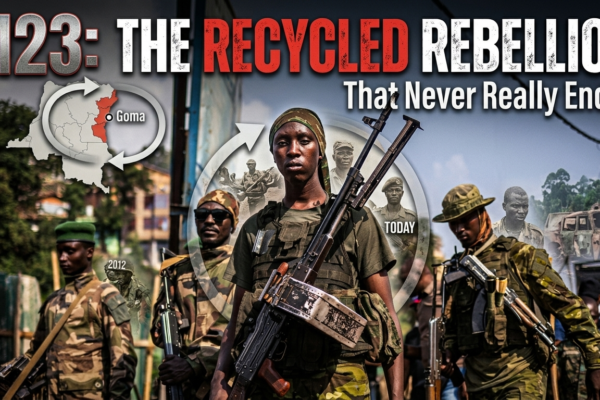
The war that resulted from this failed attempt to seize Kinshasa rapidly expanded into the largest armed conflict on the African continent since the Second World War. Nine nations eventually had forces on Congolese soil. On one side, Rwanda, Uganda, and Burundi backed two main rebel groups that emerged during August 1998. The Rally for Congolese Democracy, known as the RCD, was formed in August and composed primarily of Banyamulenge and other Tutsi fighters, based in Goma, and backed directly by Rwanda. In November 1998 a new Ugandan-backed group, the Movement for the Liberation of Congo, known as the MLC, was reported operating in northern Congo under the leadership of Jean-Pierre Bemba, son of a wealthy Congolese businessman with close ties to Mobutu. On the other side, Angola, Zimbabwe, Namibia, Chad, and Sudan provided troops and logistics to support Kabila’s government against the advancing rebels. Kabila also armed Hutu refugee militias in eastern Congo and began actively inciting Congolese public opinion against the Tutsi. On August 12, a loyalist army major broadcast a radio message from Bunia urging Congolese people to bring machetes, spears, arrows, hoes, spades, rakes, nails, truncheons, electric irons, barbed wire, stones, and anything else available to kill Rwandan Tutsi. Several public lynchings of Tutsi occurred in the streets of Kinshasa in the days that followed.
Rwanda simultaneously asserted a territorial claim that had not been made publicly before. The Rwandan government challenged current borders by claiming a substantial part of eastern Congo as historically Rwandan territory. The claim was not new in its logic, but its public articulation in the context of an active military occupation of those territories made explicit what the First Congo War’s conduct had suggested: Rwanda’s interest in eastern Congo was not limited to security against the FDLR’s predecessors. It extended to the territory itself and to the mineral resources within it. Throughout the war, Rwandan soldiers and their allied groups captured and operated lucrative coltan and diamond mines. In April 2001, a UN panel of experts investigating the illegal exploitation of diamonds, cobalt, coltan, gold, and other resources formally accused Rwanda, Uganda, and Zimbabwe of systematically exploiting Congolese resources. Grokipedia’s analysis of the conflict, drawing on UN expert reports, noted that mineral profits comprised approximately twenty to fifty percent of Rwanda’s and Uganda’s informal export earnings during the conflict period.
On November 6, 1998, following a request by Nelson Mandela to advance peace talks, Paul Kagame admitted for the first time that Rwandan forces were assisting the RCD rebels inside the DRC. The admission, which came three months after the invasion had begun, followed the pattern established during the First Congo War: deny during the operation, admit when the denial is no longer diplomatically necessary. The international community received the admission without significant consequence for Rwanda. Diplomatic efforts to end the war accelerated, but the fighting continued.
The conflict produced some of the war’s most extraordinary moments of naked self-interest between nominal allies. Rwandan and Ugandan forces, officially aligned against Kabila, fought three separate battles in the city of Kisangani between 1999 and 2002 over control of the diamond trade in that area. The city that both armies nominally occupied as allies was fought over between them repeatedly, with each new occupation bringing looting and waves of displaced civilians. The battles of Kisangani illustrated as clearly as any single episode in the war that the stated political objectives of the intervention, security against Hutu militias and protection of Tutsi communities, did not account for the military behaviour of the forces actually fighting it.
On July 10, 1999, the six countries with active forces in the DRC, Rwanda, Uganda, Angola, Zimbabwe, Namibia, and the DRC government itself, signed the Lusaka Ceasefire Agreement in Zambia. The Lusaka Accord provided for an immediate cessation of hostilities, the withdrawal of all foreign troops, the disarmament of militias, and the deployment of a United Nations peacekeeping force. The UN Security Council subsequently established the Mission of the United Nations in the Democratic Republic of Congo, known as MONUC, with an initial authorisation of 5,537 troops. The RCD and MLC also eventually signed onto the agreement. None of the accord’s main provisions were immediately implemented. Laurent Kabila blocked the deployment of UN peacekeepers in government-held territory. Rwanda and Uganda maintained their forces in eastern Congo. Fighting continued across multiple fronts.
On January 16, 2001, Laurent-Desire Kabila was shot in his office at the Palais de Marbre in Kinshasa. He was subsequently transported to Zimbabwe for medical treatment and died of his wounds. The circumstances of the assassination remain contested. His son, Joseph Kabila, then twenty-nine years old and largely unknown internationally, was installed as president within days. The younger Kabila proved more willing than his father to negotiate with Rwanda and Uganda and to open dialogue with the international community. Under his leadership the diplomatic processes that had stalled under his father began to move. Rwanda signed the Pretoria Accord in 2002, providing for the withdrawal of its forces in exchange for DRC commitments on the neutralisation of the FDLR and other Hutu armed groups. The war officially ended on July 18, 2003 with the establishment of the Transitional Government of the Democratic Republic of the Congo.
The human cost of the Second Congo War is documented in estimates that range between devastating and catastrophic depending on the methodology used. The International Rescue Committee calculated that approximately 3.8 million people died between August 1998 and April 2004, the majority from disease and malnutrition caused by the displacement and destruction of communities rather than from direct violence. Later analyses extended the accounting to include deaths through 2008, producing estimates of up to 5.4 million total. The war drew in nine nations and approximately 25 armed groups. It was, by these measures, the deadliest conflict in the world since the Second World War.
What ended in 2003 was not the conflict in eastern Congo. It was the formal multi-state war. The underlying dynamic that had produced both the First and Second Congo Wars remained entirely intact. Rwanda retained its interest in eastern Congo’s territory and resources. The FDLR and its affiliated Hutu armed groups remained present in the Kivus and continued to provide Kigali with its stated security justification for maintaining influence across the border. The Congolese state, weakened by a decade of war, remained unable to exercise effective authority over its eastern provinces. The armed groups that the Lusaka Accord had required to be disarmed were not disarmed. They evolved, merged, split, and re-formed under different names. The group that would eventually become the CNDP and then M23 was already developing its networks in the years immediately after the 2003 peace settlement. The pattern established across 1996, 1997, and 1998, of Rwandan military intervention, proxy rebel formation, mineral extraction, and international impunity, did not end with the Transitional Government. It adapted to whatever political environment existed and continued, as this series has documented through to the present day.