
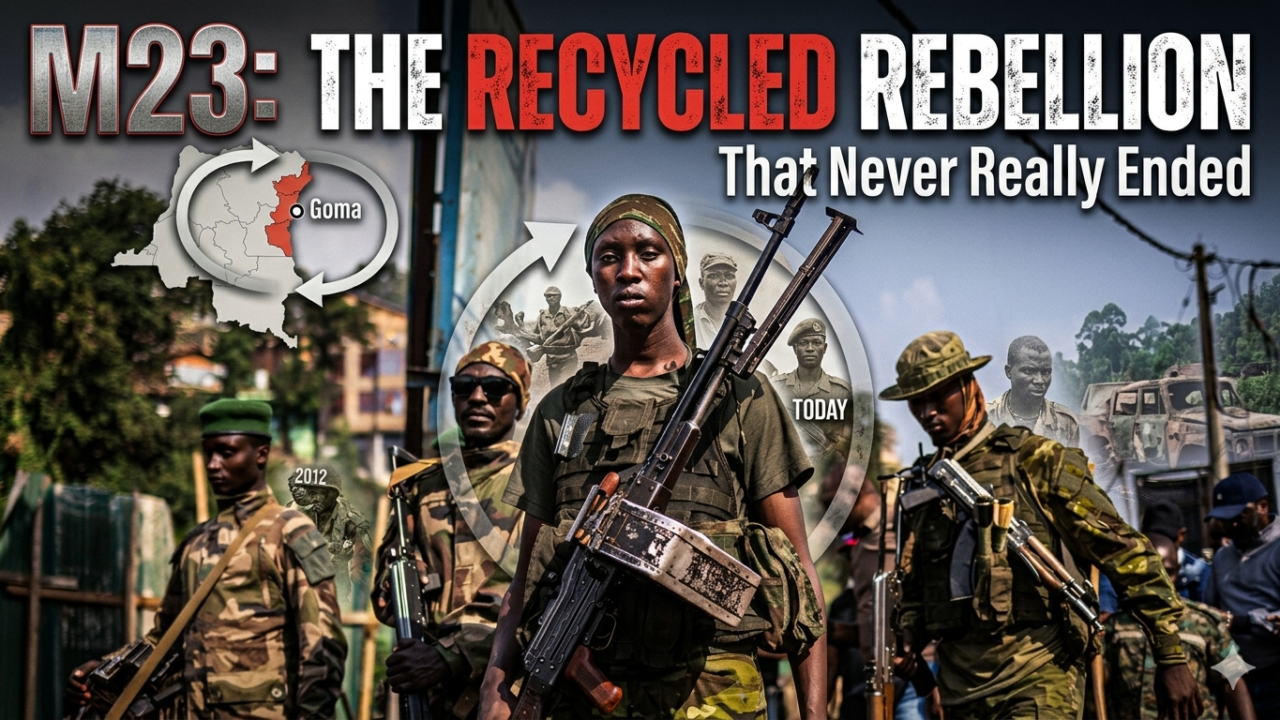
The March 23 Movement did not appear in 2012. It was assembled from components that had been in continuous operation, with varying names and configurations, since the end of the Second Congo War in 2003. Understanding M23 requires understanding what preceded it, because the commanders, the backers, and the objectives did not change across the different iterations. What changed were the names, the immediate political justifications offered, and the international pressure that periodically forced a rebranding. The substance remained constant.
After the formal end of the Second Congo War, Rwandophone militants in eastern DRC who were unwilling to return to Rwanda formed the National Congress for the Defence of the People, known as the CNDP, under former Rwandan Patriotic Front fighter Laurent Nkunda. The CNDP claimed to protect Congolese Tutsi communities and received direct support from the Rwandan government, a relationship documented by multiple UN reports during the period. In 2009, the CNDP signed a peace accord with the Congolese government on March 23, agreeing to become a political party and to integrate its fighters into the Congolese national army, known as the FARDC. Thousands of CNDP combatants were nominally integrated into the FARDC, but analysts noted immediately that the integration produced a parallel chain of command rather than genuine absorption. The former CNDP military hierarchy remained intact within the Congolese army structure, concentrated in North and South Kivu, and continued to operate according to its own loyalties rather than the national command.
The integration collapsed in early 2012. In late March 2012, General Bosco Ntaganda, a senior officer in the FARDC who had previously served in multiple rebel groups and was known in the region as “the Terminator,” led a mutiny of between 300 and 600 soldiers in North Kivu. Ntaganda had been indicted by the International Criminal Court in 2006 for war crimes committed in Ituri in 2002 and 2003, including the use of child soldiers. ReliefWeb’s contemporaneous analysis suggested the mutiny may have been triggered by indications that President Joseph Kabila was about to honour his obligations to the ICC and order Ntaganda’s arrest. Kabila formally called for Ntaganda’s arrest on April 11, 2012. On May 3 and 4, 2012, Colonel Sultani Makenga, who had been the second highest-ranking CNDP officer behind Ntaganda in the post-integration command structure, launched an apparently separate revolt. On May 6, 2012, the new rebel movement was formally constituted as the March 23 Movement. M23 took its name from the date of the 2009 peace agreement whose terms it claimed had not been honoured. According to testimony from Ugandan authorities and M23 defectors cited in the Wikipedia article on the M23 movement, Rwanda had covertly supported the emerging mutiny since as early as 2011, before Ntaganda’s mutiny began. MONUSCO’s own reporting, cited by GlobalSecurity, estimated that between 200 and 300 Rwandan soldiers were fighting within M23 ranks during this period, having been recruited, trained, and deployed from Rwanda.
The 2012 to 2013 rebellion moved quickly. M23 captured the border town of Bunagana on July 6, 2012. On November 20, 2012, M23 took control of Goma, the capital of North Kivu province and a city of approximately one million people, without firing a shot as Congolese army units retreated. The Telegraph correspondent Mike Pflanz reported this event in real time, describing an armed group entering a provincial capital with minimal resistance while the international community struggled to respond. M23 was subsequently requested to evacuate Goma by the International Conference on the Great Lakes Region after the Congolese government agreed to negotiate. The group held the city for eleven days before withdrawing. Throughout the rebellion, Human Rights Watch accused M23 of committing widespread war crimes including summary executions, sexual violence, and forced recruitment of civilians, and suggested that Rwandan officials were complicit through their continued support. ReliefWeb’s account linked Makenga specifically to the 2008 Kiwanja massacre of 67 civilians, and Colonel Baudouin Ngaruye to the 2009 Shalio massacre of 139 civilians.
The rebellion began to fracture from within in early 2013. A schism developed between Ntaganda and Makenga over the ongoing peace negotiations. M23’s political leader, Jean-Marie Runiga Lugerero, was removed on February 28, 2013, with Makenga accusing him of financial embezzlement, ethnic hatred, and political immaturity. Clashes between factions loyal to each man killed ten fighters. Ntaganda’s position within M23 became untenable. On March 18, 2013, he surrendered at the US embassy in Kigali, Rwanda, requesting transfer to the International Criminal Court. He was detained by the ICC on March 22 and made his first appearance before the court on March 26. The reasons for his surrender remain disputed. Observers speculated at the time that he had been pressured to surrender by Rwanda, or that he feared Makenga’s faction. On July 8, 2019, the ICC convicted Ntaganda on 18 of 23 counts, including murder, rape, sexual slavery, pillaging, and the use of child soldiers. He was sentenced to 30 years in prison, the longest sentence handed down by the ICC to that point.
In November 2013, the United Nations Security Council authorised the deployment of an intervention brigade within MONUSCO with a mandate to carry out targeted offensive operations against armed groups. The brigade, totalling 3,069 peacekeepers, was based in North Kivu. On November 6, 2013, Congolese government forces launched a major assault on M23 positions. The following day M23 issued a statement declaring that it had decided to end its rebellion and pursue its goals through purely political means. On November 7, Makenga surrendered at Mgahinga Gorilla National Park in Uganda with approximately 1,500 fighters. They were held in Kisoro by Ugandan authorities. M23 was, by any formal measure, defeated.
It was not destroyed. Negotiations over what would happen to surrendered fighters and their commanders stalled in Entebbe, with the Congolese government delegation walking out after failing to agree on the wording of a document intended to formally end the insurgency. The fighters held in Uganda were not tried, not disarmed in any meaningful sense, and not repatriated under conditions that would have severed their command relationships. In 2017, Makenga and between 100 and 200 of his followers fled from Uganda and set up camp at Mount Mikeno in the border area between Rwanda and the DRC, effectively resuming their insurgency on a small scale. Later UN Security Council research confirmed that Makenga’s return had initiated the gradual rearmament and restoration of M23. The Bisimwa faction’s “Revolutionary Army of Congo” joined these efforts in late 2021 by reorganising remaining fighters and recruiting new ones in cooperation with Makenga. The headquarters of the restored M23 was established at Mount Sabyinyo.
On the night of March 27, 2022, M23 rebels launched a new offensive in North Kivu, attacking the villages of Tshanzu and Runyoni in the Rutshuru Territory from their positions in the surrounding hills. The offensive that followed was categorically different in scale and ambition from everything that had preceded it. By 2022 M23 was one of 120 armed groups operating in eastern DRC, but it was the only one with what the UN Group of Experts later documented as direct and decisive Rwandan military involvement. The 2024 UN Group of Experts report, document S/2024/432, found that between 3,000 and 4,000 Rwandan Defence Force troops were present in Congolese territory, a number that possibly surpassed the estimated 3,000 M23 combatants themselves. It found that RDF military interventions went beyond support for M23 operations to constitute direct and decisive involvement. It documented the seizure of the Rubaya coltan mining site in April 2024, one of the world’s most significant coltan deposits, and found that control of mining areas was directly connected to Rwanda’s objectives in the conflict.
In April 2023, M23 merged with other armed groups to form the Congo River Alliance, known as the AFC, under the political leadership of Corneille Nangaa, the former president of the Congolese electoral commission who had been sanctioned by OFAC in 2019 for his role in delaying the 2016 elections while serving under Joseph Kabila. The AFC framing gave M23 a broader political coalition to operate within and allowed Rwanda to present the conflict as a Congolese political movement rather than a Rwandan military operation. The UN Group of Experts and the United States government both documented that the distinction was cosmetic. The military command remained Rwandan.
On January 27, 2025, M23 and the Rwanda Defence Force took full control of Goma. Bukavu fell on February 16. Both provincial capitals of the mineral-rich Kivu region were now under the control of forces that Rwanda continued to describe publicly as an independent Congolese armed movement. The June 2025 UN Group of Experts report confirmed that one week before the Goma offensive began, Rwandan officials had confidentially informed the experts that President Kagame had personally decided to take control of Goma and Bukavu. A declared ceasefire under the Washington Accord framework in 2025 was broken within days. Diplomatic talks continued in Washington through April 2026. M23 remained in Goma and Bukavu as those talks proceeded.
The trajectory from CNDP to M23 to AFC spans nearly two decades and multiple international peace processes. The peace accord of 2009 did not end the CNDP. The military defeat of 2013 did not end M23. The Nairobi process of 2022 and 2023 did not produce disarmament. The Washington Accord of 2025 did not produce withdrawal. At each stage, the group demobilised enough to reduce international pressure and then reconstituted under the same commanders with the same backers pursuing the same territorial and resource objectives. The pattern is not accidental. It is the defining feature of a thirty-year strategy in which Rwanda has repeatedly created, dissolved, renamed, and rebuilt armed proxy structures in eastern DRC while maintaining the public position that it has nothing to do with any of them. The evidence to the contrary, from the Gersony report of 1994 through to the UN Group of Experts report of July 2025, constitutes one of the most extensively documented cases of sustained state-sponsored proxy warfare in modern African history. The documentation exists. The accountability does not.