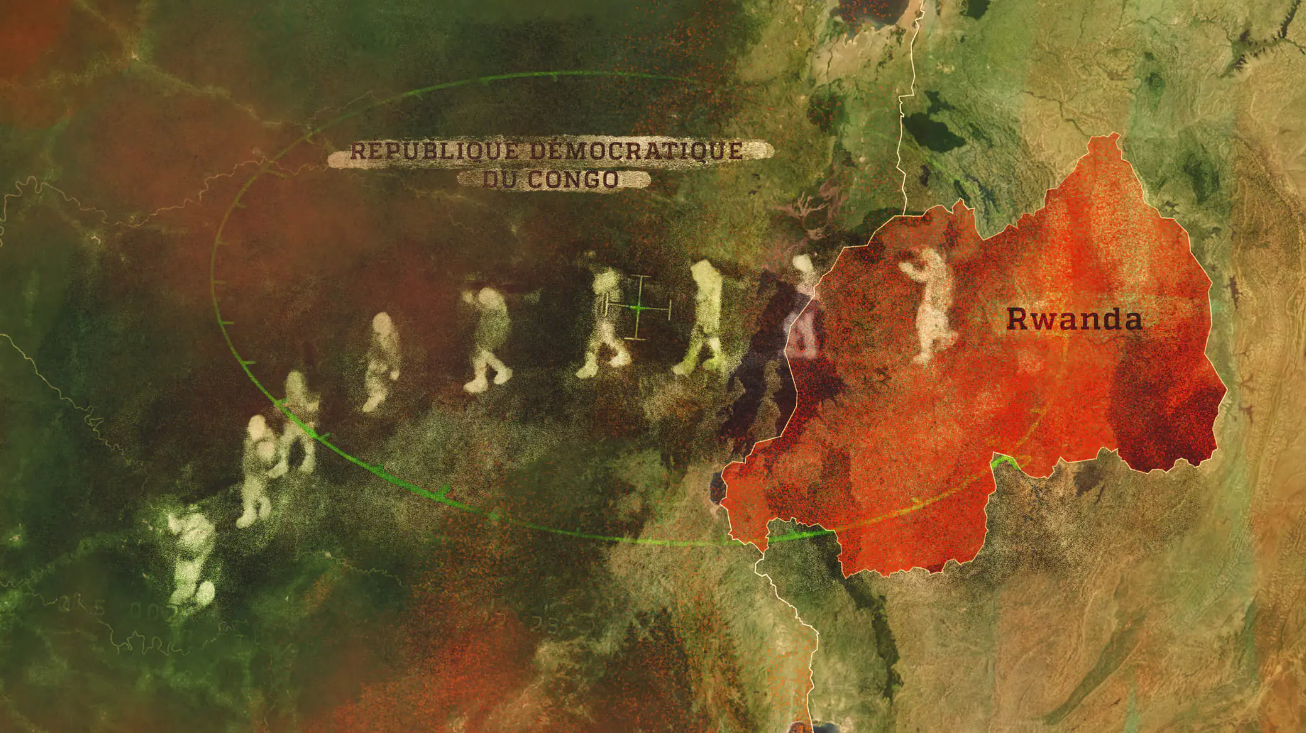

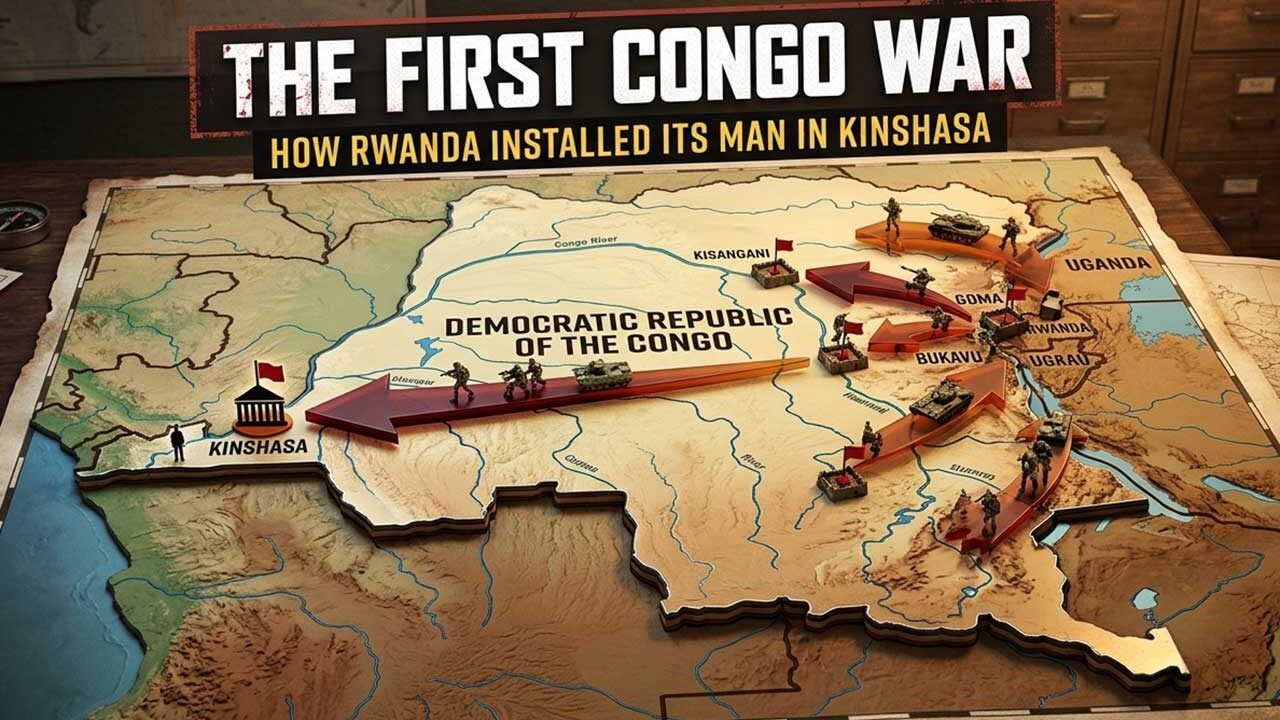
On October 18, 1996, four Congolese political exiles were convened by Rwanda to form the Alliance of Democratic Forces for the Liberation of Congo, known by its French acronym AFDL. One of them, Laurent-Desire Kabila, a former Maoist rebel who had spent much of the previous three decades running a small fiefdom in eastern Zaire and had largely disappeared from political life before the 1990s, was chosen as the alliance’s public spokesperson and co-founder. General Jules Lumumba Onangando, testifying in June 2006, confirmed that Kabila had been “virtually unknown” among the early supporters of the rebellion and had been imposed by Rwanda “for reasons that are now obvious.” The legal and political scholar Filip Reyntjens later described the First Congo War as the intersection of two overlapping agendas: a genuine resistance by Congolese Tutsi who feared reprisals from Hutu armed groups operating in the camps, and the instrumentalisation of that struggle by the Rwandan government to disguise what was from the beginning an RPA intervention into Zaire. Rwanda needed a Congolese face on a Rwandan military operation. Kabila provided it.
The groundwork for the AFDL had been laid months earlier. Rwanda had been providing military instruction and equipment to Banyamulenge units in eastern Zaire since at least mid-1996. The Banyamulenge, a Congolese Tutsi community long established in the Itombwe Mountains of Uvira Territory in South Kivu, had genuine security fears rooted in the presence of armed Hutu militia in the refugee camps that had formed after 1994. In April 1996, Banyamulenge units originating from Burundi attacked the Runingu refugee camp, killing several Burundian and Rwandan refugees, an incident that illustrated how the Banyamulenge were already being integrated into a regional military operation before the formal creation of the AFDL. The rebellion Rwanda fomented was not manufactured from nothing. The Banyamulenge had real grievances. Rwanda used those grievances as the pretext and the cover for a military operation whose actual objectives extended far beyond the security of any Congolese Tutsi community.
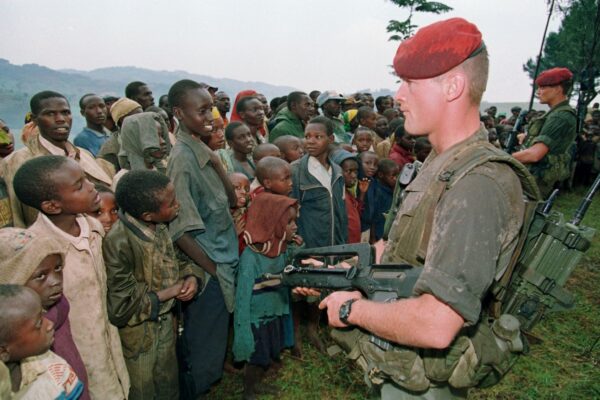
On the same day the AFDL was formally constituted, October 18, 1996, its military campaign began. Forces drawn from the Rwandan Patriotic Army, the Uganda People’s Defence Force, and the Burundian Armed Forces crossed into Zaire and rapidly moved against the refugee camps near Uvira, Bukavu, and Goma. The formal start date of the First Congo War, October 24, 1996, marks when the AFDL launched its broader offensive. The opening weeks of the campaign were organised around the camps. The camps in North and South Kivu at that point held vast numbers of people. After the RPF’s July 1994 victory in Rwanda, as many as two million Hutu had fled across the border into Zaire. The camps contained genuine refugees, civilians who had fled in fear, alongside more than 30,000 former Rwandan Armed Forces soldiers and thousands of Interahamwe militiamen who had participated in the genocide. Within those camps, disease and malnutrition alone killed at least 50,000 people in the first weeks. The armed elements within the camps had subsequently used them as bases to launch cross-border attacks into Rwanda throughout 1995 and 1996.
Six days before the AFDL’s official launch, on October 6, 1996, an armed group attacked the Lemera Hospital in South Kivu, where surgeon Denis Mukwege was then serving as medical director. The attackers pillaged medical supplies and killed approximately 37 people in their hospital beds, including Zairean soldiers, Hutu refugees, and civilians. Mukwege was not at the hospital at the time. The attack illustrated the chaos and violence that preceded and surrounded the AFDL offensive before it had formally begun, and the impossibility of separating military operations from civilian casualties in any honest account of the period.
AFDL forces captured Goma, eastern Zaire’s largest city, on November 1, 1996, breaking up the refugee camps surrounding it and, according to the Council on Foreign Relations timeline, killing tens of thousands of refugees and other civilians in the process. The fighting caused hundreds of thousands of Hutus to flee deeper into the Zairean jungle, sending more than a million refugees back into Rwanda. What followed those first weeks was documented later by the UN Mapping Report in 617 incidents, including the massacre at Tingi-Tingi near Kisangani, where tens of thousands of Hutu refugees were killed by AFDL and RPA troops. Amnesty International subsequently estimated that as many as 200,000 Rwandan Hutu refugees were massacred by AFDL and Rwandan Defence Forces during the course of the war. The true number cannot be known with certainty because the AFDL and RPA carefully managed NGO and press access to areas where atrocities were occurring, using aid agencies in some documented cases to locate and identify refugee groups hiding in forested areas before sending troops to eliminate them.
Paul Kagame denied throughout the war that Rwandan forces were present in Zaire in any command role. The international community accepted this denial with a degree of willingness that is difficult to explain except in the context of the post-genocide diplomatic environment, in which Rwanda’s government was regarded by Western powers as a victim state deserving of latitude. In 1997, after the AFDL had taken Kinshasa and the military outcome was irreversible, Kagame gave an interview to the Washington Post in which he confirmed that Rwanda had indeed organised, trained, and commanded the AFDL campaign. By that point, acknowledgement carried no cost. Mobutu had fled into exile on May 16. Kabila had declared victory on May 17 from his base in Lubumbashi, entered Kinshasa on May 20, and been formally sworn in as president on May 29. The country’s name was changed from Zaire to the Democratic Republic of the Congo. Rwanda’s man was in power. The admission that Rwanda had run the operation that put him there was a detail the international community chose not to follow up.
The depth of Rwanda’s control over the new DRC government was made concrete through the appointment of Rwandan General James Kabarebe as head of the Congolese national army, a position he held from 1997 to 1998. A Rwandan military officer was running the armed forces of a sovereign country. Alongside Rwanda and Uganda, Burundi, Angola, and southern Sudanese rebel factions had provided varying degrees of assistance to the AFDL, each motivated by their own grievances against the Mobutu regime. But the country’s military command structure now answered to Kigali. The minerals of Katanga and the Kivus, the cobalt and the coltan and the gold, were now accessible to a government that Rwanda controlled and that owed its existence to Rwandan military power.
Kabila was not a man who accepted permanent subordination. He had spent decades as an independent operator in eastern Zaire, surviving through adaptability rather than loyalty. By 1998 he had come to understand that Rwanda and Uganda expected to exercise ongoing control over his government and through it over the DRC’s eastern territories and their resources. In July 1998, fearing a coup and increasingly presenting himself as a Congolese nationalist, Kabila dismissed Kabarebe from his position as army chief of staff and ordered all Rwandan soldiers to withdraw from Congolese territory. The relationship that had produced the First Congo War collapsed in the course of a political decision that took days to implement but whose consequences took five more years of war to exhaust.
Rwanda’s response to its expulsion was swift and consistent with everything that had preceded it. On August 2, 1998, a mutiny within the Congolese military was announced on state television in Goma, leading to the formation of the Rally for Congolese Democracy, known as the RCD, a Tutsi-led rebel group backed by Rwanda. The Second Congo War had begun. Rwanda invaded the DRC for the second time, two years after its first invasion had produced the government it was now seeking to overthrow. Uganda joined. Burundi participated. Angola, Namibia, and Zimbabwe intervened on Kabila’s behalf. Nine countries were ultimately involved in what became, by casualty estimates, one of the deadliest conflicts since the Second World War.
The First Congo War is remembered in most international accounts as the fall of Mobutu, the end of a corrupt thirty-two-year dictatorship, and a moment of regional change that was at least partly driven by legitimate Congolese grievances against a failed state. That account is not wrong. Mobutu’s regime was corrupt beyond any honest defence, his army had disintegrated, and his international support had collapsed with the end of the Cold War. The Congolese population’s relief at his removal was genuine and widespread. What is also true, and what the Laurent Kabila Wikipedia article confirms directly using the testimony of the general who was present, is that Kabila was chosen by Rwanda, imposed on the Banyamulenge rebellion whose fighters had not heard of him, and used to give a Rwandan military operation the Congolese political character it required to avoid being described, accurately, as an invasion. The minerals his government then controlled, and the Rwandan military officer who commanded his army, tell the rest of the story clearly enough. Rwanda did not fight the First Congo War to stop the genocide from spreading. It fought it to remove a hostile government, install a dependent one, and establish access to the resource wealth of a country it had no legal claim to govern. The seven months from October 1996 to May 1997 were not a Congolese revolution. They were the first chapter of an occupation that, in various forms, has not ended.