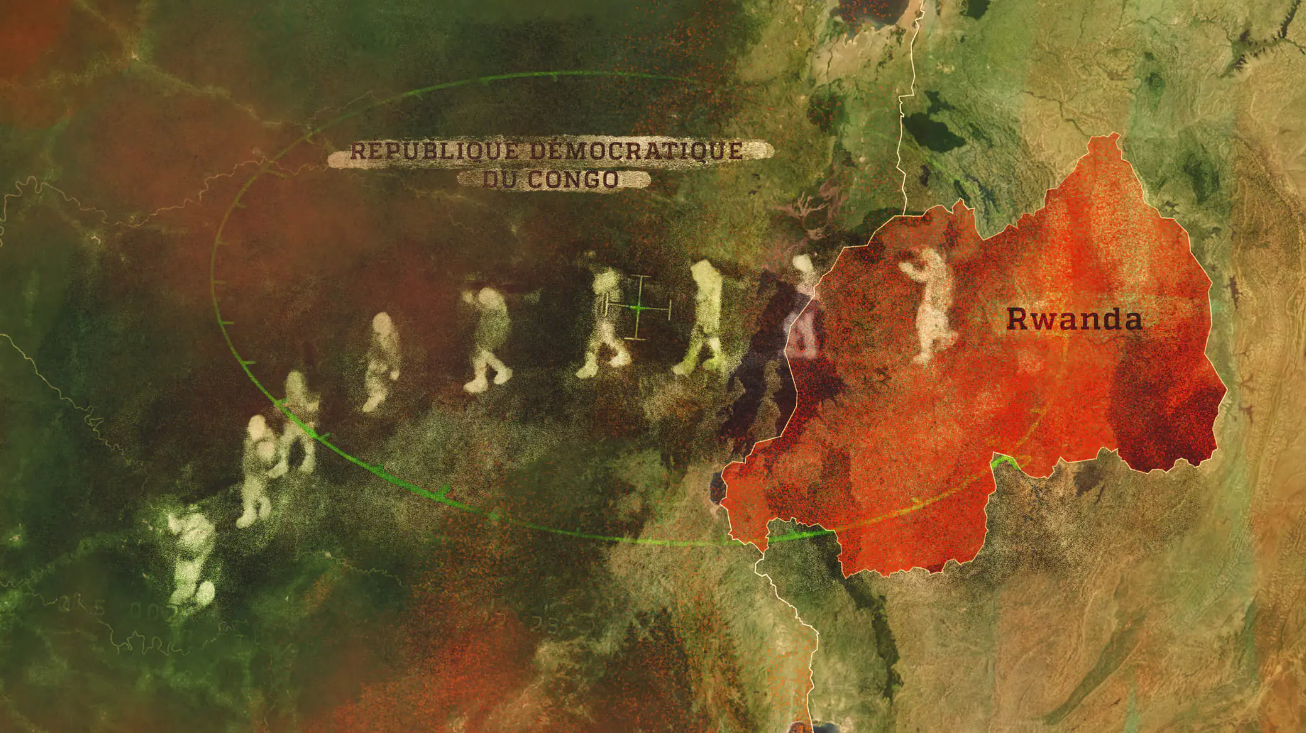

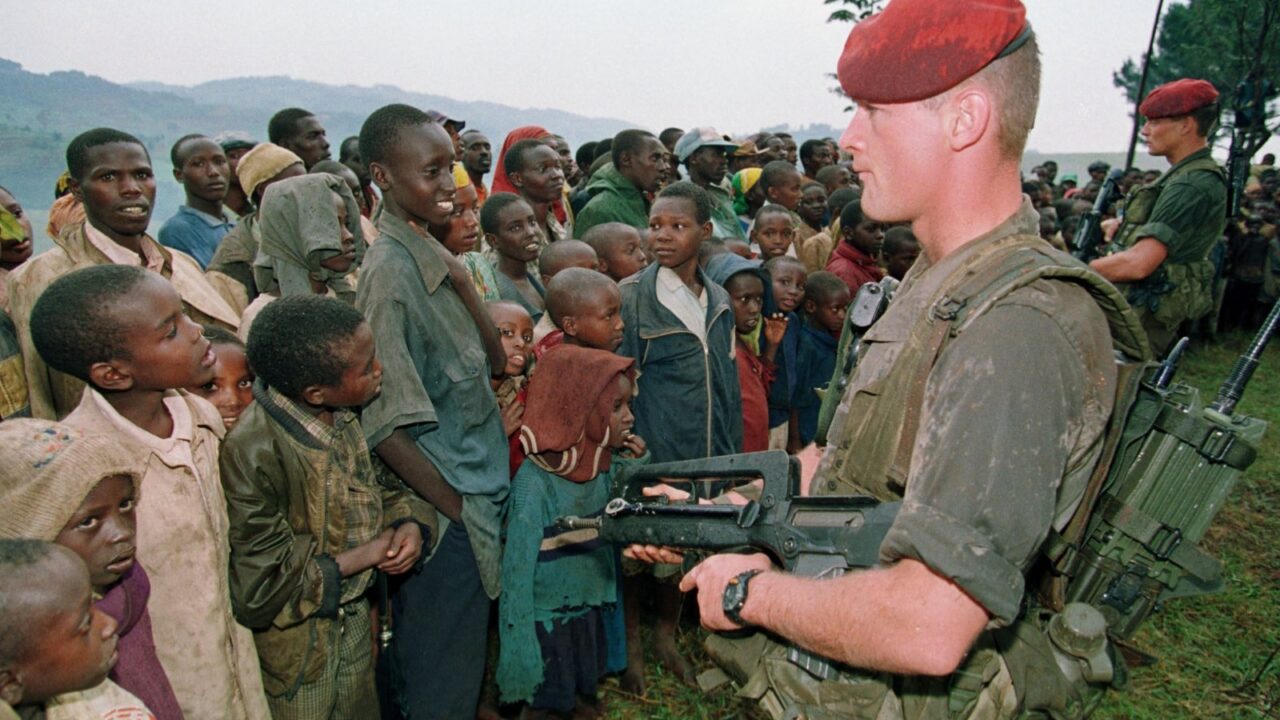
On June 22, 1994, with the Rwandan genocide nearing its end and the RPF within days of total military control of the country, the United Nations Security Council adopted Resolution 929 by a vote of ten in favour and five abstentions. Brazil, China, Nigeria, Pakistan, and Rwanda itself abstained. The resolution authorised a French-led multinational force to establish a humanitarian safe zone in southwestern Rwanda. France named the operation Turquoise. The following day, June 23, the first contingents of approximately 2,500 French troops entered Rwanda through Cyangugu prefecture from Bukavu in Zaire, equipped with 100 armoured personnel carriers, ten helicopters, four Jaguar fighter bombers, eight Mirage fighters, and a battery of 120mm mortars. The force was, by any military measure, substantial. The genocide it was authorised to stop had, by that point, already killed more than 500,000 people over eleven weeks.
The timing alone was damning. The RPF, which had resumed its military offensive after the genocide began on April 7, had been advancing steadily for months. By late June it held the majority of the country and was closing in on the remaining areas under the genocidal interim government’s control. French Prime Minister Edouard Balladur told the Security Council on July 22 that France had a “moral duty” to act without delay and that “without swift action, the survival of an entire country was at stake.” The RPF and many African nations observed that France had not found this moral duty pressing enough to act during the eleven weeks in which most of the killing took place. France had, however, found it pressing enough to maintain a military cooperation agreement with Habyarimana’s government since 1975, to assist the government militarily against the RPF when it invaded from Uganda in October 1990, and to keep French military advisers embedded in Rwandan army units up to and through the early weeks of the genocide itself. A list prepared by Rwandan army officers within the Ministry of Defence, dated March 5, 1994, documented three French nationals working as technical assistants in the reconnaissance battalion, two French flying instructors in the air corps, a navigator, an air traffic controller, and a mechanic, plus four French nationals including a major in the French Army serving with the para-commandos.
Human Rights Watch reported that some French military officers in Paris had spoken openly of breaking the back of the RPF before the operation launched. The French were not intervening to stop a genocide in its final days. They were intervening, in the assessment of HRW and multiple independent analysts, to prevent a complete RPF victory and to protect what remained of France’s strategic position in a country it considered part of its Francophone sphere of influence. The RPF was English-speaking, Uganda-backed, and represented to French strategic planners the advance of Anglophone influence into a Francophone ally state. France had opposed it militarily since 1990. Operation Turquoise was, in this reading, the final instrument of that opposition.
The safe zone France established covered the Cyangugu-Kibuye-Gikongoro triangle in southwestern Rwanda, occupying approximately one fifth of the country’s territory. Within that zone, France’s presence saved lives. Radio France Internationale estimated that approximately 15,000 people were freed from internment sites and protected from further killing, including roughly 12,000 Tutsi from the Nyarushishi camp near Cyangugu who faced imminent execution by Interahamwe militias. The UN’s own independent inquiry later acknowledged the humanitarian assistance provided within the zone. These facts are not in dispute and they matter. What is also not in dispute, and what matters equally, is what happened outside the moments of genuine rescue, and what happened at the zone’s edges as the operation wound down.
The case of Bisesero is the most documented and most damning. The Bisesero hills in Kibuye prefecture had been home to a Tutsi population of approximately 60,000. From the beginning of the genocide in April, the Tutsi of Bisesero organised a self-defence that held off Interahamwe attackers for weeks using stones, spears, bows, and arrows. Other Tutsi survivors from surrounding areas joined them, making Bisesero the largest single concentration of active Tutsi resistance in the country. On June 27, 1994, French special forces commander Lieutenant Colonel Jean-Remy Duval, known by the alias Diego, travelled to the Bisesero area with a group of journalists including Patrick de Saint-Exupery of Le Figaro. A local teacher guided them to the hills where they encountered survivors in extreme condition. De Saint-Exupery later described a child whose left buttock had been cut off and a man whose right arm had been severed. The survivors were alive, but barely. The French commander was informed of the situation and understood what he had found.
The French did not return to rescue those survivors for three days. On June 30, when the French finally went back to Bisesero, they found that hundreds of survivors had been killed in the intervening period. The Interahamwe had continued attacking the hill throughout those three days, and French forces were positioned five kilometres away. The French army has never contested the three-day gap. The reasons for it remain disputed. A 2021 commission report commissioned by the Rwandan government concluded that the delay was deliberate, intended to give the militias time to complete their work before French forces could be implicated in their rescue. French prosecutors later recommended dropping the investigation into the conduct at Bisesero. Professor Phil Clarke of SOAS University noted the strong resonance with the conduct of Dutch peacekeepers at Srebrenica. The Paris Court of Appeal accepted six lawsuits from genocide victims against the French army in May 2006, raising charges of complicity in genocide and crimes against humanity. Those cases have proceeded slowly through French courts in the decades since.
The operational consequence of Operation Turquoise that most directly connects to the Congo wars was not what happened in Bisesero. It was what happened at the zone’s borders as the RPF completed its military victory and the interim government collapsed. The French military escorted former Rwandan Armed Forces soldiers, government officials, and Interahamwe militiamen through the Turquoise zone toward the Zairean border. They did not disarm them. In some documented cases, French forces supplied retreating genocidal forces with food, weapons, and vehicles. The genocidal authorities in the areas under French control were openly welcoming of the French presence, displaying the French flag on their own vehicles while simultaneously killing Tutsi who came out of hiding seeking protection, believing the French flag meant safety.
The result was a mass movement of armed and organised genocidal forces into Zaire. The refugee camps that formed around Goma and Bukavu within days of the RPF taking Kigali on July 4 and completing its military victory on July 18 were not simply masses of frightened civilians. Estimates compiled by UNHCR and the UN indicated that the camps contained up to 50,000 former Rwandan Armed Forces soldiers alongside thousands of Interahamwe militiamen who had conducted the genocide. Those forces quickly established dominance within the camps, taking control of humanitarian aid distribution, taxing civilian refugees, and using camp structures to reorganise, rearm, and conduct military training. They launched cross-border incursions into Rwanda from positions within the camps. They were not disarmed by UNHCR, which lacked the mandate and capacity to do so. They were not disarmed by Zaire, which lacked the will and the means. They were not disarmed by the international community, which had just watched 500,000 people be killed and done very little, and was now focused on managing the humanitarian optics of the refugee crisis it had helped create.
The refugee camps were also not positioned at the distance from Rwanda’s border that international humanitarian standards required. The internationally recommended minimum distance was fifty miles. The camps around Goma and Bukavu were a fraction of that distance. This proximity made the cross-border military activity of the former Rwandan armed forces and Interahamwe not merely possible but operationally convenient. Rwanda had a genuine security grievance: armed genocidal forces were regrouping on its border under cover of a humanitarian operation that the international community felt unable to disrupt without being seen to punish genocide survivors alongside their persecutors.
France’s Parliamentary Commission on Rwanda published its report on December 15, 1998, examining French conduct before and during the genocide. It acknowledged failures but did not reach the conclusion that France bore responsibility for enabling the escape of genocidaires. A later inquiry by the Muse commission in France, established by President Macron, released its findings in March 2021 and concluded that France bore “heavy and overwhelming” responsibilities in the genocide, acknowledging in particular that France had been “blind” to the preparations for genocide and had prioritised its strategic relationships over the lives of Rwandan civilians. It stopped short of finding criminal responsibility. Rwanda’s own commission, the Mucyo commission, reached harsher conclusions, accusing French officials of direct participation in the genocide and of deliberate protection of perpetrators during Operation Turquoise.
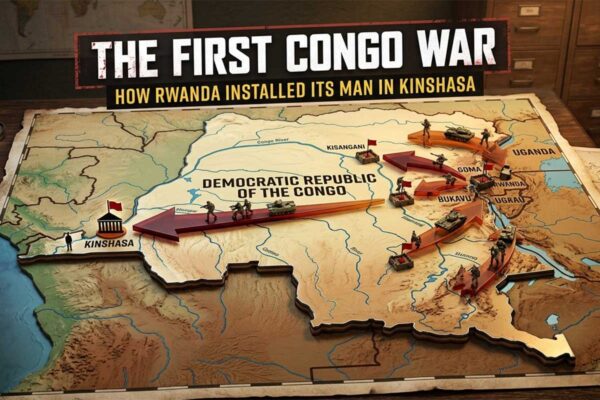
The connection between Operation Turquoise and the First Congo War two years later is direct and documented. The génocidaires who reached Zaire through the Turquoise corridor arrived armed, organised, and under the leadership structures of the former Rwandan state. They formed what became the nucleus of the FDLR’s predecessors and the armed Hutu groups that conducted cross-border attacks into Rwanda throughout 1995 and 1996. Those attacks gave the Rwandan government a genuine military justification for responding. Whether what followed in October 1996, when Rwanda sent its army across the border to attack the camps and their surrounding populations, was a proportionate counter-insurgency or a deliberate campaign of mass killing against Hutu civilians is documented in 617 incidents across 550 pages of the UN Mapping Report. France did not cause the First Congo War. It created the conditions in which Rwanda’s choice to wage it became, at least in legal argument, defensible. The génocidaires France escorted to Zaire gave Rwanda the enemy it needed. What Rwanda did to everyone else in Zaire, combatant and civilian alike, is a separate accounting that no French military operation can be blamed for, and that Rwanda has never answered for either.