

Rwanda has denied military involvement in the Democratic Republic of Congo since 1996. That denial has remained structurally identical across nearly three decades, through three major wars, five distinct rebel configurations, and at least six major United Nations reports. The words change slightly. The substance does not. The evidence gathered against the denial has grown from a single mapping exercise to an annual body of documented findings involving photographs, defector testimonies, intercepted communications, satellite imagery, and the accounts of RDF soldiers captured on Congolese soil. The denial has never changed in response to any of it.
This article documents the pattern. It places Rwanda’s official statements alongside the UN findings they were made in response to, from 1996 through to 2025. The purpose is not analysis. It is the record.
The Original Denial: 1996 to 1997
When Rwanda, alongside Uganda, launched the military operation that became the First Congo War in October 1996, the official Kigali position was that Rwanda was not involved. The AFDL, the Alliance des Forces Democratiques pour la Liberation du Congo-Zaire, was presented as a Congolese liberation movement fighting to overthrow Mobutu Sese Seko. Paul Kagame initially denied that Rwandan forces were participating. He later confirmed, in an interview with the Washington Post in 1997, that Rwanda had indeed organised, trained, and commanded the AFDL campaign. By that point Mobutu had fallen, Laurent-Desire Kabila was in Kinshasa, and acknowledgement of Rwanda’s role carried no diplomatic cost.
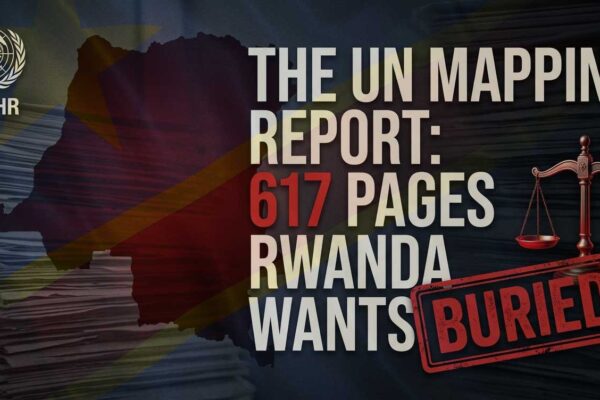
The 2010 UN Mapping Report, published fourteen years after those events, documented what happened during and after the campaign. It recorded 617 serious incidents of violations of human rights and international humanitarian law between March 1993 and June 2003. It found that Rwandan Patriotic Army forces and their AFDL allies conducted what it described as an “apparently relentless pursuit and mass killing of Hutu refugees” resulting in the deaths of “several tens of thousands.” It raised the question of whether those killings constituted crimes of genocide under international law. Rwanda called the genocide allegations “absurd and irresponsible” and threatened to withdraw its peacekeeping troops from Darfur if the report was published. The report was published. Nobody was prosecuted.
The Second Congo War and the Pattern Established: 1998 to 2003
In July 1998, Laurent-Desire Kabila expelled all Rwandan military personnel from the DRC. Rwanda responded by backing a new rebel movement, the Rally for Congolese Democracy, known as the RCD, and launching what became the Second Congo War on August 2, 1998. Rwanda denied that its military was directly involved in combat operations inside the DRC throughout this period, describing its presence as a defensive measure against the threat posed by Hutu armed groups, particularly the predecessors of what became the FDLR.
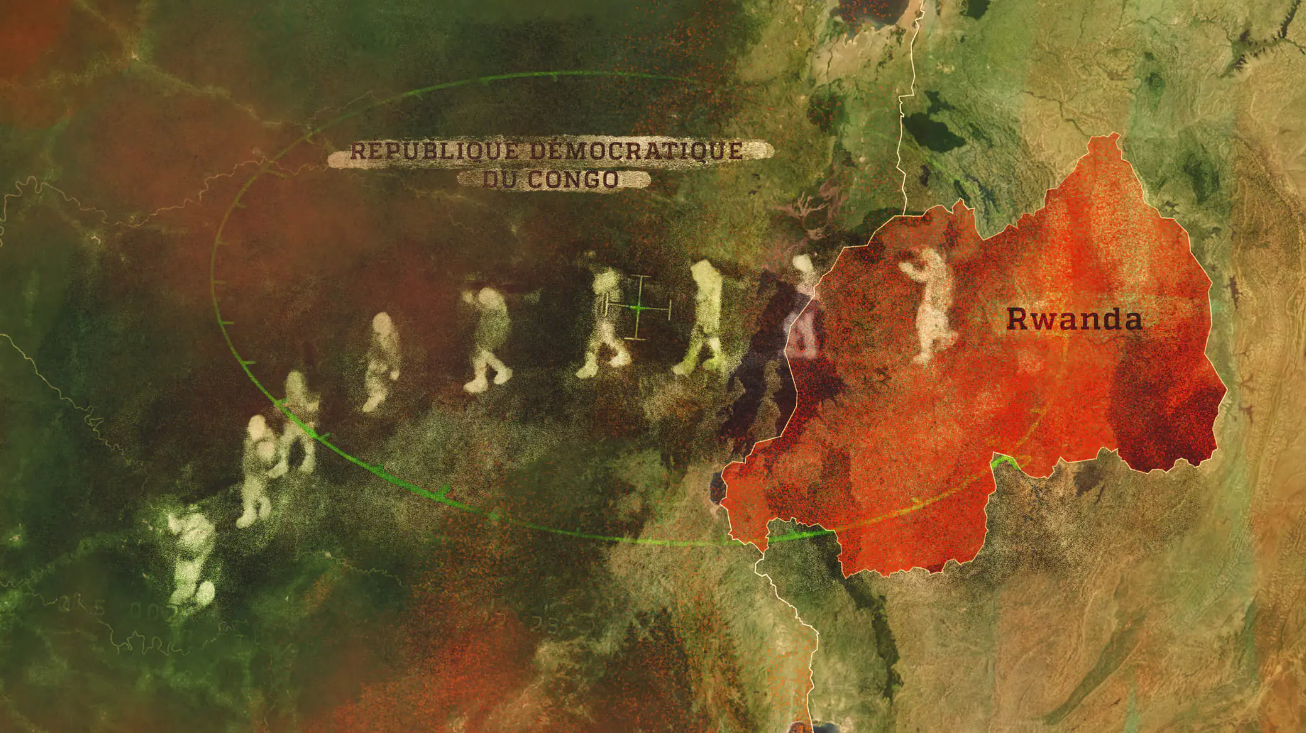
The UN Mapping Report documented the Second Congo War period extensively and found serious violations by all parties, including Rwandan forces and their allied groups. A peace process concluded in 2003. Rwanda withdrew its forces. The eastern DRC remained destabilised, with dozens of armed groups operating across North and South Kivu. Many of those groups, according to later UN reporting, maintained links to Rwandan intelligence and military structures.
The pattern that would define the next two decades was now established. Rwanda intervenes militarily in eastern DRC. Rwanda denies the intervention. Evidence accumulates. An international process concludes. Rwanda withdraws. A proxy structure remains. The cycle begins again.
M23 First Phase: 2012 to 2013
M23 emerged in April 2012 from a mutiny within the Congolese national army. Its core membership came from former fighters of the National Congress for the Defence of the People, known as the CNDP, a previous Rwanda-backed rebel group whose fighters had been nominally integrated into the Congolese army under a 2009 peace agreement. M23 takes its name from the date of that agreement, March 23. By November 2012, M23 had captured Goma, the capital of North Kivu province, and held it for eleven days before withdrawing under international pressure.
Rwanda denied supporting M23. In November 2012, a defecting RDF soldier was surrendered to MONUSCO at Kiwanja, which the Congolese government cited as direct evidence of Rwandan participation. The DRC expelled Rwanda’s ambassador from Kinshasa in October 2012 in response to what it described as Rwandan complicity. Several Western countries, including the United States and the United Kingdom, suspended aid to Rwanda in 2012 over its support for M23. M23 was defeated militarily in November 2013 by a UN intervention brigade operating alongside the Congolese army. Many of its fighters fled into Rwanda and Uganda. Rwanda denied they were there.
The Return: 2021 to 2022
M23 resumed armed operations in eastern DRC in November 2021. By early 2022 it had launched what became its most sustained offensive in years. Rwanda denied any role in the resurgence. In August 2022, a 131-page report by the UN Security Council’s Group of Experts found that Rwanda had launched military interventions inside Congolese territory since at least November 2021, providing “troop reinforcements” for specific M23 operations “in particular when these aimed at seizing strategic towns and areas.” The experts cited what they described as “solid evidence.” Rwanda’s government spokesperson Yolande Makolo said the government would not comment on what she called an “unpublished and unvalidated report,” and said an earlier report from the same group “contained none of these false allegations.”
In October 2022, an RDF soldier defected to MONUSCO at Kiwanja, providing further direct evidence of Rwandan military presence. By January 2023, the United States, several European countries, and the UN Group of Experts all confirmed their assessment that Rwanda was supporting M23. Makolo responded by saying: “The DRC has all the power to de-escalate the situation if they want to, but until then Rwanda will continue to defend itself.” The framing of Rwanda as a defensive actor, reacting to Congolese provocation, remained the consistent public position.
What the UN Found in 2024
The UN Group of Experts final report for 2024, document S/2024/432, released in July 2024, found that between 3,000 and 4,000 Rwandan Defence Force troops were present on Congolese territory, a number that according to the report possibly surpassed the estimated 3,000 M23 combatants themselves. It found that RDF military interventions in Rutshuru, Masisi, and Nyiragongo territories went “beyond mere support for M23 operations to direct and decisive involvement, allowing RDF and M23 to achieve military dominance.” The report documented that M23 seized the Rubaya mining site in April 2024, one of the world’s most significant coltan deposits, and that control of this and other mining areas was directly connected to Rwanda’s objectives.
Rwanda’s response in July 2024 was consistent with every previous response. Makolo said the DRC had “all the power to de-escalate the situation.” The Rwandan government also stated, through its official channels, that “Rwanda has no mineral companies in the DRC,” a claim made in direct response to the minerals dimension of the UN findings.
The ceasefire agreement negotiated by Angola in August 2024 was notable for one reason that was widely observed at the time. Angola negotiated it directly between the DRC and Rwanda, not between the DRC and M23. As the International Centre for Counter-Terrorism noted in its analysis of the agreement, this diplomatic approach effectively acknowledged Rwanda’s role as a state supporter of M23, despite its official denials. M23’s military leader Willy Ngoma responded to the ceasefire announcement by ordering a new offensive the following day, asserting that only M23 itself could sign a ceasefire with the Congolese government.
The Fall of Goma and the 2025 Evidence
On January 27, 2025, M23 and the Rwanda Defence Force took full control of Goma, the capital of North Kivu province and home to over one million people. Bukavu, the capital of South Kivu, fell on February 16. The two provincial capitals of the mineral-rich Kivu region were now under the control of a force that Rwanda continued to describe as an independent Congolese armed group that Rwanda was not directing.
The UN Group of Experts June 2025 report documented what happened. The report stated that “one week prior to the Goma attack, Rwandan officials confidentially informed the Group that President Paul Kagame had decided to imminently take control of Goma and Bukavu.” It stated that “following RDF additional reinforcements, on 27 January 2025, AFC/M23 and RDF took full control of Goma town.” It found that AFC/M23 leaders and Rwandan government officials told sources that “AFC/M23 would not leave the occupied areas, whatever the outcome of the negotiations” and that “the time for agreements has passed.” It documented that sources close to the Rwandan government reported that Rwanda’s final objective was “to control the territory of the DRC and its natural resources.”
The July 2025 report from the same group, document S/2025/446, found that the RDF’s “successive military engagements did not primarily aim at neutralizing the FDLR, or halting an alleged existential threat posed to Rwanda.” It concluded that “RDF reinforcements and decisive military operations aimed at conquering additional territories, while RDF’s continued presence enabled AFC/M23 to consolidate control.” It found that the RDF had operated from a command headquarters in Gisenyi, directly across the border from Goma.
Rwanda’s response to the June 2025 report came from President Kagame himself, speaking at a press conference in Kigali on July 4. He said the reports “were written long ago” and that the experts came “just to confirm a narrative they already had.” He compared the UN experts to an arsonist who burns a house and then acts as judge and prosecutor. Makolo described the reports as continuing to “misrepresent the reality and distort the facts of the conflict in eastern DRC.”
The US Sanctions and Rwanda’s Response
In March 2026, the United States Treasury Department imposed sanctions on Rwanda’s military and four of its senior officials for what it described as “direct operational support” of M23. The sanctioned officials were Vincent Nyakarundi, the RDF army chief of staff; Ruki Karusisi, a major-general; Mubarak Muganga, chief of defence staff; and Stanislas Gashugi, special operations force commander. The Treasury Department stated that M23’s territorial gains “would not have been possible without Rwandan backing.” The State Department separately called on Rwanda to “end its support for M23 immediately and withdraw RDF troops and advanced weaponry from the DRC.”
Makolo responded that the sanctions “unjustly” target Rwanda and “misrepresent the reality and distort the facts of the conflict.” She accused the DRC of violating peace agreements and said Rwanda was “fully committed to disengagement of its forces in tandem with the DRC implementing their obligations.”
The DRC severed diplomatic relations with Rwanda on January 26, 2025, one day before Goma fell.
The Structure of the Denial
Across twenty-nine years, Rwanda’s denial of military involvement in the DRC has followed a consistent structure that is worth naming precisely.
The first element is the deflection to the FDLR. Every Rwandan response to evidence of its presence in the DRC returns to the argument that the Democratic Forces for the Liberation of Rwanda, a Hutu armed group whose original founders included some perpetrators of the 1994 genocide, poses an existential security threat to Rwanda that requires military action inside Congolese territory. The 2025 UN Group of Experts report directly addressed this argument, finding that the RDF’s engagements “did not primarily aim at neutralizing the FDLR.” Kagame’s refusal to attend the Luanda summit in December 2024, which was designed to address FDLR neutralisation, was noted by multiple analysts as undermining Rwanda’s own stated justification for its presence.
The second element is the delegitimisation of the UN process itself. Rwanda has, at various points, described UN expert reports as politically motivated, biased, based on fabricated evidence, and written in advance of the facts they purport to document. Kagame’s July 2025 comparison of UN experts to arsonists sits within this long pattern of institutional rejection rather than factual rebuttal.
The third element is procedural delay. Rwanda consistently describes reports as “unpublished and unvalidated” before official release, then responds to the official release by saying the reports contain “false allegations,” then participates in peace processes that pause the international pressure, and then resumes military operations when the diplomatic attention moves elsewhere. This cycle has repeated across the 2012 to 2013 M23 period, the 2022 resurgence, and the 2025 Goma offensive.
The fourth element is the offer of a counter-grievance. Rwanda consistently points to DRC’s cooperation with the FDLR as a justification for its own actions, framing the conflict as bilateral rather than as a case of Rwandan aggression against a weaker neighbour. This framing has been partially effective in diplomatic contexts, where Western governments have sometimes accepted a “both sides” framing that the UN’s own expert findings do not support.
What the Evidence Shows
The evidentiary record that has accumulated against Rwanda’s denial is drawn from multiple independent sources across multiple decades. It includes the testimonies of RDF soldiers captured or surrendered in the DRC. It includes photographic and video evidence of Rwandan troops crossing the border, documented in 2022. It includes satellite imagery showing the expansion of the Kanombe military cemetery in Kigali, with at least 600 new graves dug since the beginning of the M23 offensive, consistent with significant Rwandan military casualties in the DRC. It includes the accounts of sources close to the Rwandan government interviewed by UN experts. It includes the statements of Rwandan officials who, in confidential communications documented by the Group of Experts, confirmed that Kagame personally decided to take Goma. And it includes the simple diplomatic fact that Angola negotiated the 2024 ceasefire with Rwanda, not with M23, because all parties understood who was actually directing the war.
None of this evidence has resulted in accountability. Rwanda remains a major contributor to UN peacekeeping missions. It continues to receive international development assistance. Paul Kagame continues to be received at diplomatic summits. The denial continues.
And in eastern DRC, as this article is written, M23 and the Rwanda Defence Force occupy Goma and Bukavu. More than seven million people are internally displaced across the country, according to UNHCR. The conflict has created one of the world’s most significant humanitarian crises. Rwanda says it has nothing to do with it.