

On October 1, 2010, the United Nations Office of the High Commissioner for Human Rights published a 550-page report documenting, in clinical and methodical detail, 617 of the most serious violations of human rights and international humanitarian law committed in the Democratic Republic of Congo between March 1993 and June 2003. The report had already been leaked to the French newspaper Le Monde on August 26, triggering a diplomatic crisis that reached the office of the UN Secretary-General. Rwanda threatened to withdraw its more than 3,000 troops from the peacekeeping mission in Darfur, part of a total deployment of over 3,500 Rwandan troops across UN missions worldwide, if the document was published with its most damaging findings intact.
The UN published it anyway. In the last days of September, Paul Kagame backed down from the threat. The report went out on October 1.
Fifteen years later, not a single individual has been prosecuted for the crimes it documented. No international tribunal has been established. The confidential database of alleged perpetrators, held in Geneva, has never been opened. The conflict in eastern DRC, which the report traced directly to this period of unaddressed impunity, continues to this day.
This is the report Rwanda has spent fifteen years trying to bury. Here is what it actually says.
What the Report Is and How It Was Built
The UN Mapping Report was not a political document produced in response to a particular crisis. It was a methodical legal exercise that began after three mass graves were discovered in Rutshuru, North Kivu, in September 2005, containing human remains from the 1996 to 1997 conflict period. Several UN bodies agreed the following year to recommend a formal mapping exercise. The Secretary-General advised the Security Council of this intention in June 2006, and the terms of reference were approved in May 2007. In December 2007, the Security Council formally endorsed the exercise in Resolution 1794.
The mapping exercise began in July 2008. Between October 2008 and May 2009, a total of 33 staff worked on the project inside the DRC, including Congolese and international human rights experts and lawyers. Of those 33, approximately 20 were field human rights officers deployed across five regional offices, conducting direct witness interviews and gathering documentary evidence on the ground. The exercise was led by Luc Cote, a Canadian attorney experienced in investigating and prosecuting international crimes. The report was submitted to the High Commissioner for Human Rights in June 2009 for review and finalisation.
The research base is substantial. More than 1,280 individual witnesses were interviewed. More than 1,500 documents were collected and analysed. Every incident listed in the report is backed by at least two independent sources. This is not allegation assembled from rumour. It is a documentary record constructed to the standards required for eventual judicial proceedings.
617 Incidents: What Was Documented
The report covers four distinct periods. The first, from March 1993 to June 1996, documents 40 incidents from the final years of Mobutu’s regime. The second period, from July 1996 to July 1998, covers the First Congo War and the early Kabila presidency, and contains the most serious findings in the entire document. The third period covers the Second Congo War from 1998 to 2003. The fourth addresses violations outside these main conflict periods. The report itself acknowledges that the decade it covers was “probably one of the most tragic chapters in the recent history of the DRC,” a period “marked by a string of major political crises, wars and multiple ethnic and regional conflicts that brought about the deaths of hundreds of thousands, if not millions, of people.”
Twenty-one armed Congolese groups are named. The military forces of eight foreign states are documented as operating inside DRC during this period, including Rwanda, Uganda, Burundi, Angola, and Zimbabwe. The report does not spare any actor. But its most consequential findings concern the actions of the Rwandan Patriotic Army, known as the RPA, and its Congolese proxy force, the Alliance des Forces Democratiques pour la Liberation du Congo-Zaire, known as the AFDL. The report also documents massive and systematic sexual violence committed by all combatant forces across the decade, including the rape of Hutu refugee women and children during the 1996 to 1997 period that had previously gone largely undocumented.
What Rwanda’s Army Actually Did: The Systematic Pursuit
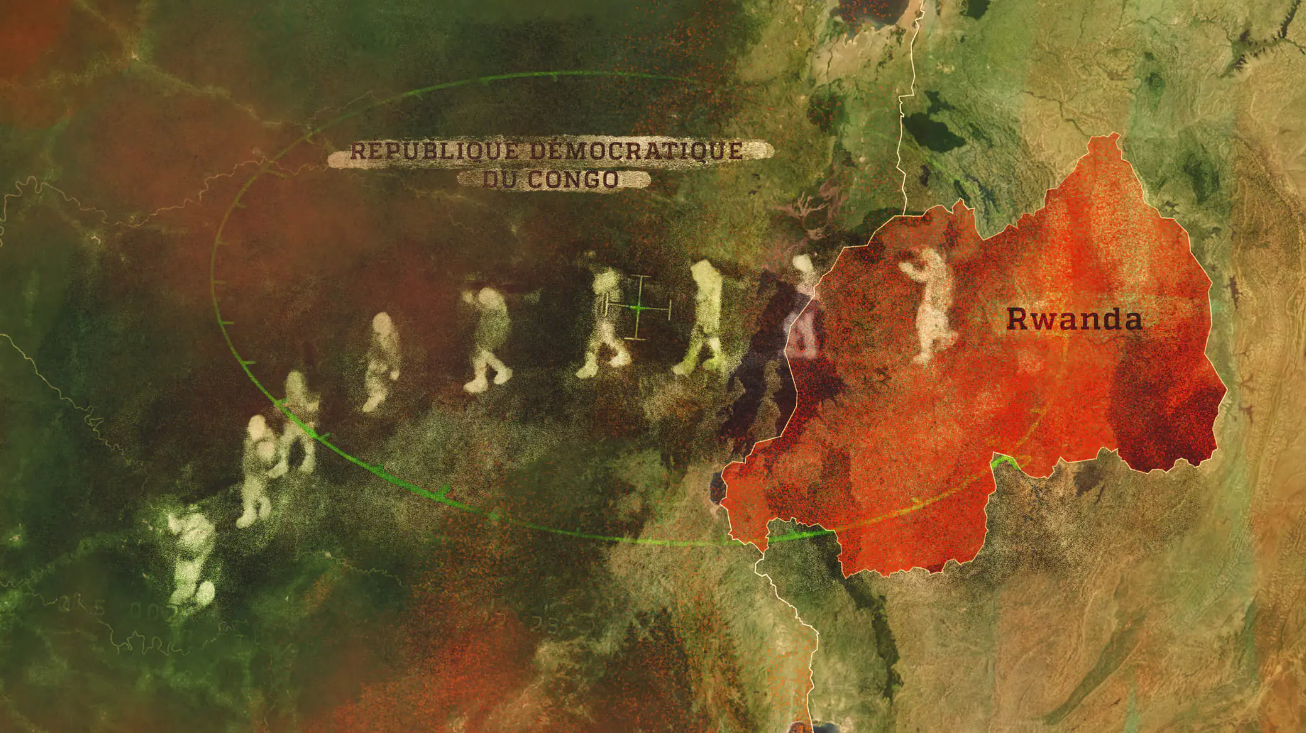
In October 1996, RPA forces crossed into eastern Zaire and attacked refugee camps in South Kivu and North Kivu. The camps in South Kivu held approximately 527,000 Rwandan Hutu refugees, and those in North Kivu held approximately 718,000. The early attacks cost the lives of between 6,800 and 8,000 refugees and forced the repatriation of between 500,000 and 700,000 people back to Rwanda. Survivors who did not return fled westward into the Congolese interior.
What followed those initial attacks is described in Paragraph 513 of the report in language that deserves to be read directly, because no paraphrase fully captures it. The report states that the attacks resulted in an “apparently relentless pursuit and mass killing of Hutu refugees,” resulting in the deaths of “several tens of thousands.” It states that “the extensive use of edged weapons (primarily hammers) and the apparently systematic nature of the massacres of survivors after the camps had been taken suggests that the numerous deaths cannot be attributed to the hazards of war or seen as equating to collateral damage.” It adds that “the majority of the victims were children, women, elderly people and the sick, who were often undernourished and posed no threat to the attacking forces.”
The word “hammers” appears in an official UN document describing the method used to kill tens of thousands of people across months of operations spanning hundreds of kilometres of Congolese territory. MSF archives, confirmed independently, documented the systematic nature of these massacres in real time as they were occurring in 1996 and 1997.
The report documents a specific and repeated method used across multiple provinces. Elements of the AFDL and RPA would summon victims to public meetings, on the pretext of discussing repatriation, introducing them to the new authorities, or distributing food. Those who attended were subsequently killed. The report confirms this method was used in Musekera, Rutshuru, and Kiringa in October 1996. An example is documented for October 30, 1996, when 350 Congolese Hutu were killed by AFDL units using hammers in Rutshuru town centre, after soldiers had appealed to civilians from the village of Kiringa to attend a public meeting. The same pattern was documented in Mugogo and Kabaraza in November 1996, at least eight locations in December 1996, and continuously across North Kivu, South Kivu, and Orientale Province through 1997, including mass killings at Kisangani in May and June of that year.
The pursuit continued as survivors moved west. The attacks and killings intensified as refugees moved westward as far as 1,800 kilometres from the original camp sites. The UN Joint Commission later identified 134 separate sites across DRC where such atrocities were committed.
The report also documents that Congolese Hutu who had no connection to the 1994 genocide in Rwanda, people whose families had lived in Zaire for generations, were targeted alongside Rwandan Hutu refugees at public meetings and roadblocks. The report states that “the numerous attacks against the Hutus in Zaire who were not part of the refugees seem to confirm that it was all Hutus, as such, who were targeted.”
The Genocide Question: What the Report Actually Said
The most contested finding of the report is also the most carefully worded. The investigators did not declare that genocide was committed. Paragraph 513 states that the attacks “reveal a number of inculpatory elements that, if proven before a competent court, could be characterised as crimes of genocide.” But the report goes further in Paragraph 518, which states that “it seems possible to infer a specific intention on the part of certain AFDL and APR commanders to partially destroy the Hutus in the DRC, and therefore to commit a crime of genocide.” Both paragraphs reserve the legal conclusion for a court of law, which is the appropriate position for an investigative body.
The report acknowledged factors that could complicate a genocide finding in court. Very large numbers of Rwandan Hutu refugees were repatriated to Rwanda with RPA assistance rather than killed. In some locations at the start of the war, women and children were separated from men before the men were killed, which might indicate targeted rather than total destruction of the group. These are genuine legal complexities and the report engages with them honestly.
But the report is equally clear about what cannot be explained away. The attacks were systematic. They covered an enormous geographic area. They continued over many months. They used consistent methods across many separate incidents. They targeted Congolese Hutu with no connection to Rwanda’s internal history. And at the time, the report states, “the Hutu population in Zaire, including refugees from Rwanda, constituted an ethnic group as defined in the Convention on the Prevention and Punishment of the Crime of Genocide.” At minimum, the report concludes, the documented actions constituted crimes against humanity and war crimes. The genocide question, in the report’s own framing, can only be resolved by a full judicial investigation that has never been conducted.
How Rwanda Tried to Kill the Report
Rwanda received an advance copy of the report in July 2010. The response was immediate. The government dismissed the findings as “absurd and irresponsible,” claiming the report was instigated by political opponents of the Rwandan government. Rwanda applied significant pressure on Secretary-General Ban Ki-moon to block publication. It encouraged other African states to reject the document. Uganda, also named in the report, issued a statement saying the findings undermined its resolve to contribute to peacekeeping operations.
Rwanda’s most direct threat came from Foreign Minister Louise Mushikiwabo, who told reporters on August 31: “Starting with Darfur, we have instructed our force commander to make contingency plans for immediate withdrawal as we wait to see how the UN treats this report.” She continued: “The UN can’t have it both ways. You can’t have a force serving as peace keepers and it is the same force you are accusing of genocide.” In a separate exchange, Mushikiwabo told journalist Philip Gourevitch: “If it is endorsed by the UN and it is ever published, the moment it is released, the next day all our troops are coming home. Not just Darfur, all the five countries where we have police.”
The threat worked, at least partially. Ban Ki-moon flew to Kigali in September to speak directly with Kagame about Rwanda’s concerns, in what observers described as an effort to manage the crisis. Publication was delayed by one month to give implicated governments time to append their comments. There is credible reporting that the language in the genocide findings was softened during that period. Despite all of this, the report was published on October 1. Kagame withdrew the Darfur threat in the final days of September. The document went out. And then, slowly, the world moved on.
Why Justice Never Came
The report itself identified the central obstacle to accountability: the Congolese justice system lacked the capacity to prosecute the crimes it documented. The ICC’s jurisdiction in DRC covers only crimes committed after July 1, 2002, placing the entirety of the 1996 to 1997 period outside its reach. The UN Security Council could establish a special tribunal, as it did for the former Yugoslavia and for Rwanda itself following the 1994 genocide, but the United States and United Kingdom have consistently blocked such a mechanism for Congo.
The reasons are not difficult to identify. Rwanda is a strategic partner of Western governments, a model of post-conflict reconstruction in the narrative that Washington and London promote across Africa. Any serious accountability process for crimes in Congo would unravel that narrative entirely. It would also raise uncomfortable questions about the willingness of donor governments to arm, fund, and politically protect a government whose military is documented, in a United Nations report, as having conducted systematic massacres of civilians across hundreds of kilometres over a period of many months.
There is also the question of minerals. The report itself devotes an entire chapter to resource exploitation, noting that “the struggle between different armed groups for access to, and control over, the DRC’s resources served as a backdrop to the violations perpetrated against the civilian population.” Accountability in Congo would require dismantling the commercial networks through which those resources move. Those networks connect Kigali to trading houses, smelters, and technology manufacturers in Europe, Asia, and North America. The international community has shown no appetite for that reckoning.
The confidential database held in Geneva, which reportedly includes senior figures among those named as bearing responsibility for the most serious incidents documented, has never been made available for prosecutorial use.
What the Report Means Today
In 2025, M23 forces with documented Rwandan military support occupy Goma. RDF troops are present across eastern DRC. Civilians continue to die in the same provinces where the 1996 to 1997 massacres took place. The pattern the Mapping Report documented, of Rwandan military involvement, systematic public denial, civilian casualties, and international silence, has not changed. It has simply continued for another fifteen years.
The UN Mapping Report is not a historical document about a closed chapter. It is the evidentiary foundation for understanding the war that is happening right now. It established, on the record and in 550 pages, that what occurred in Zaire between 1996 and 1997 was not the collateral damage of a counter-insurgency operation. It was a systematic campaign against a civilian population. It was documented by 33 investigators over months of field work. It was backed by more than 1,500 primary documents and testimony from more than 1,280 witnesses. It was published by the United Nations despite a sitting head of state using his country’s peacekeeping deployments as leverage to bury it.
The full report can be read on the OHCHR website. Rwanda has built fifteen years of impunity on the assumption that almost nobody will.