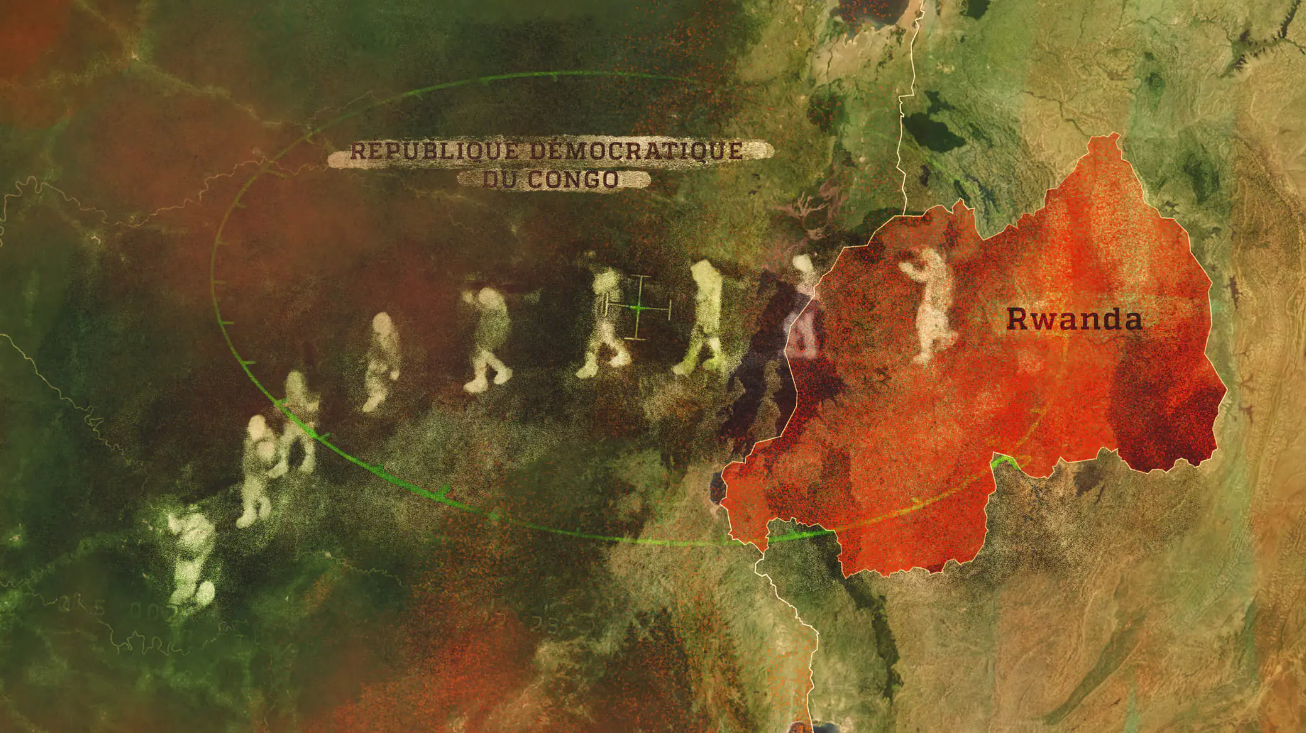

The war Rwanda has been waging in the Democratic Republic of Congo is described in most international reporting as beginning in October 1996, when Rwandan Patriotic Army troops crossed into Zaire and attacked Hutu refugee camps along the border. That date marks when Rwandan soldiers entered Congolese territory in their first major offensive. It does not mark when the strategy behind that offensive was formed, nor does it describe the pattern of military conduct that preceded it inside Rwanda itself. Understanding what happened in Zaire in 1996, and everything that has followed across nearly three decades, requires beginning two years earlier with events that Rwanda’s government has most effectively kept out of the dominant historical narrative.
The Rwandan Patriotic Front was founded in December 1987 by Rwandan Tutsi living in exile in Uganda, many of whom had served as senior officers in President Yoweri Museveni’s National Resistance Army during the Ugandan Bush War of the early 1980s. Fred Rwigema and Paul Kagame were among its founding leaders. Both had risen to senior positions in the Ugandan military. Rwigema had been appointed Uganda’s deputy minister of defence and deputy army commander-in-chief, second only to Museveni in the military chain of command. Kagame served as acting chief of military intelligence. The combat experience those years provided, along with the weapons, equipment, and supplies drawn from the Ugandan national army, gave the RPF its military foundation and its conviction that armed force was the path to political power in Rwanda.
On October 1, 1990, the RPF launched an invasion of Rwanda from Uganda with approximately 7,000 fighters. Rwigema led the opening assault and was killed the following day, October 2, at Nyabwishongezi in what was then Umutara Prefecture, ten kilometres from the Ugandan border. Kagame, who had been on a military training course at the Command and General Staff College in Fort Leavenworth, Kansas, returned to Rwanda on October 8 to take command. The civil war that followed lasted until August 4, 1993, when the Arusha Accords were signed, a power-sharing agreement intended to integrate the RPF into Rwandan politics and allow exiled Rwandans to return. The agreement was never implemented. Hutu extremists within President Habyarimana’s government opposed it, the transitional structures it prescribed were never established, and military integration did not occur.
On April 6, 1994, President Juvenal Habyarimana’s aircraft was shot down near Kigali International Airport, killing everyone on board including Burundian President Cyprien Ntaryamira. The identity of those responsible has been the subject of multiple investigations, with both Hutu extremists and the RPF named as suspects by different inquiries. French investigating judge Jean-Louis Bruguiere issued an indictment pointing to the RPF in 2006, though a later French inquiry in 2012 appeared to exonerate Kagame. The question remains formally unresolved. What is not in dispute is what followed within hours of the crash. Hutu extremist militias and elements of the Rwandan armed forces began the systematic killing of Tutsi civilians and moderate Hutus. Over approximately 100 days, more than 500,000 Tutsi were killed and an estimated 250,000 to 500,000 women were raped. The RPF resumed its military offensive, and by July 4, 1994, its forces captured Kigali, installed a transitional government under President Pasteur Bizimungu, and effectively ended the genocide. Kagame became vice president and minister of defence, the de facto ruler of the new Rwanda.
The international narrative of 1994 Rwanda was built on a moral clarity that was, in significant part, accurate. Tutsi civilians were being systematically massacred. The international community failed to intervene with the force required to stop it. The RPF ended the killing. That narrative, however, was not the complete picture of what occurred in 1994, and the United Nations knew it within months of the genocide ending.
In the summer of 1994, the United Nations High Commissioner for Refugees hired an American consultant, Robert Gersony, to conduct a refugee survey across Rwanda. The purpose was straightforward: to assess whether it was safe for Hutu refugees in neighbouring countries to return home. Gersony’s team was granted free movement by the RPF government, which expected the survey to produce findings that would support its repatriation efforts. Between August 1 and September 5, 1994, Gersony and his team visited 91 sites across 41 of Rwanda’s 145 communes and conducted interviews in nine refugee camps in surrounding countries. They had access to more of the country than any other foreign team operating at the time.
What they found was not what anyone had anticipated. In Butare, Kibungo, and parts of Kigali, Gersony’s team documented what they described in their findings as an “unmistakable pattern” of systematic killings of Hutu civilians by RPF soldiers. The pattern was consistent across multiple locations and included the summoning of civilians to public meetings after which those present were killed, house-to-house killings, and organised searches for civilians hiding in the countryside and bush. The team concluded that the great majority of those killed “had apparently not been motivated by any suspicion whatsoever of personal participation by victims in the massacres of Tutsi in April 1994.” Gersony’s personal estimate, presented to the UN Commission of Experts in Geneva on October 11, 1994, was that between 25,000 and 45,000 people had been killed by the RPF between April and August 1994, at a rate of between 5,000 and 10,000 per month.
The findings were devastating and they triggered an immediate crisis inside the UN system. UNHCR head Sadako Ogata was informed and reported to Secretary-General Boutros Boutros-Ghali. The head of the UN peacekeeping mission in Rwanda, General Guy Tousignant, told government ministers privately that Gersony was probably correct and that the killings needed to stop. UNHCR suspended its repatriation programme to Rwanda in response. The response of the international community to the findings was not prosecution, investigation, or public disclosure. The Gersony report was classified as confidential by the UN Commission of Experts. Gersony was instructed never to discuss his findings publicly, a restriction he largely honoured. No final written report was ever officially published. The UN publicly denied the report’s existence for years afterward. A memorandum drafted for US Secretary of State Warren Christopher confirmed the UNHCR team’s findings independently and noted that the killings appeared designed to reduce the Hutu male population and discourage refugees from returning to reclaim their land. That memorandum was also not made public.
According to Gerard Prunier’s account in his book “Africa’s World War,” Kofi Annan, then Under-Secretary-General for Peacekeeping at the United Nations, personally informed Kagame, Interior Minister Seth Sendashonga, Prime Minister Faustin Twagiramungu, and President Bizimungu that the UN would withhold the report from public release to allow the RPF government time to consolidate, while providing them a copy of its contents. The price of that international silence was never repaid. The pattern of RPF killings of Hutu civilians, documented by the UN’s own investigators within months of the genocide ending, was allowed to pass without accountability. That unaddressed pattern did not stop. It continued into 1995.
By early 1995, the large internally displaced persons camps that had been established in Rwanda’s former French-controlled safe zones housed approximately 350,000 people. The RPF government wanted the camps closed. It regarded them as sheltering genocide perpetrators alongside ordinary civilians who feared returning to their home communities. From January 1995 onward, according to the Wikipedia account of the Kibeho massacre drawing on multiple documented sources, the killings of Hutu civilians that the Gersony report had documented resumed after a period of relative restraint. The internally displaced persons refused to leave the camps and return to their villages, where they believed further violence awaited them.
On April 17, 1995, the prefect of Butare announced that all camps in the prefecture would close immediately. On April 18 at 3.00 in the morning, two battalions of RPA soldiers surrounded the Kibeho camp, the largest internally displaced persons camp in Rwanda, holding between 80,000 and 100,000 people and spanning nine square kilometres. A contingent of 32 Australian soldiers from the 2nd Battalion, Royal Australian Regiment, serving under UNAMIR along with a Zambian infantry company, were present at the camp. They had been dispatched from Kigali when the camp closure was announced.
The operation began with RPA soldiers firing shots into the air to move people along. Tension escalated over the following days as soldiers dismantled shelters and confined the population to specific areas. On April 22, 1995, RPA troops encircled the remaining population, herding people along the camp’s ridges, and opened fire. The Australians present watched as the RPA attacked massed civilians with machine guns, mortars, grenades, and machetes. Private Wayne Jones of the 2nd Battalion later described watching “the RPA kill thousands of people” and witnessing “many murders of unarmed women and children,” adding that the RPA soldiers “seemed to be enjoying it.” Major Carol Vaughan-Evans, the officer commanding the casualty collection post at Kibeho, was among the four Australians later awarded the Medal for Gallantry for their actions that day, the first gallantry medals awarded to Australians since the Vietnam War.
The Australians estimated that at least 4,000 people were killed. The RPA forced them to stop counting bodies when soldiers realised what the Australians were doing. Approximately 400 to 500 bodies remained uncounted, not including those that had already been removed before the Australians began their count. Scholar Gerard Prunier put the total figure at over 5,000 as a conservative estimate. MSF, which had a medical team present at the camp, publicly described what its personnel witnessed as the deliberate massacre of displaced persons by the Rwandan army. The Rwandan government’s official death toll was 338, a figure it attributed primarily to a stampede. One Australian participant later wrote that had the Australian soldiers not been present as witnesses, the RPA would in all likelihood have killed everyone in the camp.
The Rwandan government acknowledged a small number of casualties and the world accepted the framing and moved on. No RPA commander was prosecuted for the Kibeho killings. The International Criminal Tribunal for Rwanda, which prosecuted dozens of Hutu officials and officers for their role in the genocide, never brought charges against any RPF member for Kibeho or for the killings documented in the Gersony report. Former ICTR Prosecutor Carla Del Ponte later confirmed in her memoir that her office had gathered evidence on RPF crimes, had opened a case, and had been blocked from proceeding. The United States, Rwanda’s most important diplomatic partner, used its influence to ensure no RPF prosecution moved forward at the tribunal.
When the RPF took full military control of Rwanda on July 4, 1994, an estimated 1.2 million to 2 million Hutu civilians fled into Zaire, principally into North and South Kivu, alongside soldiers and officials of the former genocidal regime. The UN Mapping Report later confirmed an influx of approximately 1.2 million refugees entering the DRC following the genocide. The camps that formed around Goma and Bukavu were genuine humanitarian disasters. They also contained, mixed among the civilian population, armed elements of the former Rwandan Armed Forces and Interahamwe militias who had participated in the genocide and were now regrouping, rearming, and staging cross-border attacks into Rwanda. This created a genuine security problem for the new Rwandan government that has been acknowledged by virtually every serious analyst of the period.
What Rwanda chose to do in response to that security problem, and how far beyond any proportionate counter-insurgency the response went, is the subject of every article that follows in this series. The Gersony report had documented that the RPF’s approach to Hutu civilians during and after the genocide extended far beyond targeting combatants or genocide perpetrators. The Kibeho massacre had demonstrated that the RPA would kill thousands of unarmed civilians, including women and children, in a camp it controlled, under the eyes of UN peacekeepers, and face no accountability whatsoever. The question of what the same army would do to Hutu refugees in the ungoverned vastness of Zaire, far from UN witnesses and international journalists, was answered beginning in October 1996. The answer is documented in 617 incidents across 550 pages of the UN Mapping Report, a document that this series has already examined in detail. This article is the context that makes those 617 incidents comprehensible. These were not random acts of military excess. They were the continuation of a pattern that had been established, documented, suppressed, and rewarded with impunity for two years before a single Rwandan soldier crossed into Zaire.