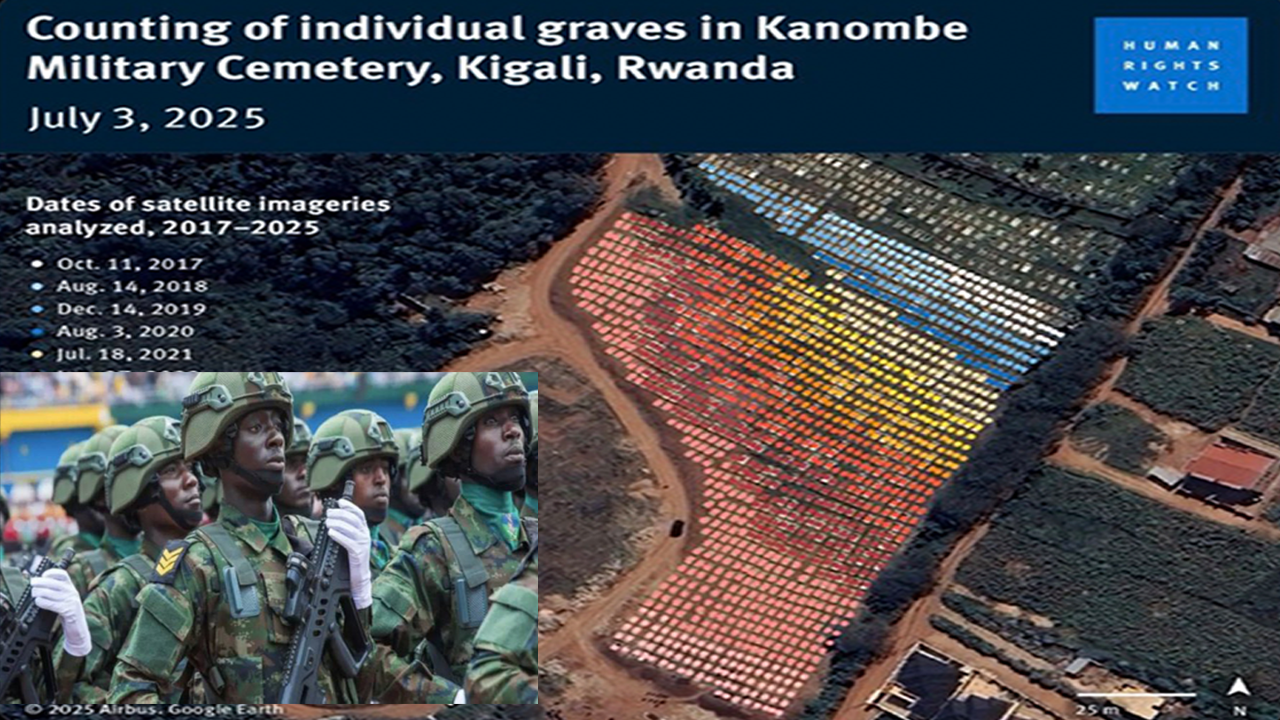
Human Rights Watch recently released satellite analysis of Kanombe Military Cemetery in Kigali, Rwanda. By examining 14 high-resolution images from 2017 to July 2025, HRW identified a sharp rise in freshly dug graves — with the steepest increase between 2022 and 2025. Each new burial plot was color-coded according to the date range in which it first appeared, revealing a striking visual record of mortality trends.
Kanombe is not an ordinary cemetery. It is reserved exclusively for members of the Rwandan Defense Force and other state security personnel. Civilians are not buried there. This fact is crucial: a sudden expansion in graves is not a reflection of Rwanda’s general population, but of its military. When Kanombe grows, it means soldiers are dying.
Between 2017 and 2021, when conflict in eastern DRC was relatively calm, HRW detected only modest additions of new graves. But from 2022 onward — as the M23 rebellion escalated against the Congolese army (FARDC) — the pace of new burials accelerated dramatically. Put simply: when war flares in eastern Congo, Kanombe fills with soldiers.
HRW counted the new individual graves using high-resolution satellite imagery at 14 different times, from Jan 2017 to July 2025, and calculated the average increase per week between each date. 2/11 pic.twitter.com/WrPgBMXrP7
— Human Rights Watch (@hrw) September 4, 2025
The evidence is powerful but not absolute. Satellite imagery shows where and when soldiers were buried, not exactly how or where they died. Official burial records, family testimonies, or independent forensic access would be needed to prove battlefield deaths in DRC beyond doubt. Still, the timing and military-only nature of Kanombe make the link difficult to dismiss.
Rwanda has consistently denied deploying troops inside the Democratic Republic of Congo. Yet Kanombe’s expanding graveyard tells another story. The silence around these burials deepens suspicion that the Rwandan Defense Force is sustaining significant losses in a war it claims not to be fighting.
This matters beyond Rwanda and Congo. Western governments, especially the United States, continue to deepen cooperation with Kigali — from trade deals to controversial deportation arrangements. At the same time, Washington and Brussels impose sanctions on individuals tied to M23 and call for Rwanda to end its support for the group. The result is a glaring contradiction: punishing Rwanda’s alleged proxy war with one hand, while rewarding Kigali with economic and diplomatic partnerships with the other.
Kanombe Military Cemetery has become a silent witness. It reflects the cost of conflict in eastern Congo, the secrecy of Rwanda’s military strategy, and the contradictions of an international system that condemns destabilization while quietly empowering those accused of driving it.
If Kanombe’s graves reflect rising military deaths, how should Rwanda’s denials of involvement in eastern Congo be interpreted?
Should international partners like the U.S. continue signing new deals with Kigali while satellite evidence suggests deeper military entanglement in DRC?